 Tick&
Tick&
Open source — AGPL
A service desk you steer, not one you endure.
Tick& is open-source, self-hosted ITSM ticketing software, built for several organisations in a single installation: entities form a tree, and the separation between them is enforced by PostgreSQL itself, not by conditions somebody can forget to write. A local authority holding its member councils, a hospital group, a managed service provider keeping its clients' tickets in one database: that is the case the architecture is built around. The rest is a complete service desk, and asset and inventory management is deliberately out of scope: Tick& handles the service desk, and nothing else.
Sign in as sophie / tick — or one of the
four other accounts, each showing a different scope. Resets on
the hour.
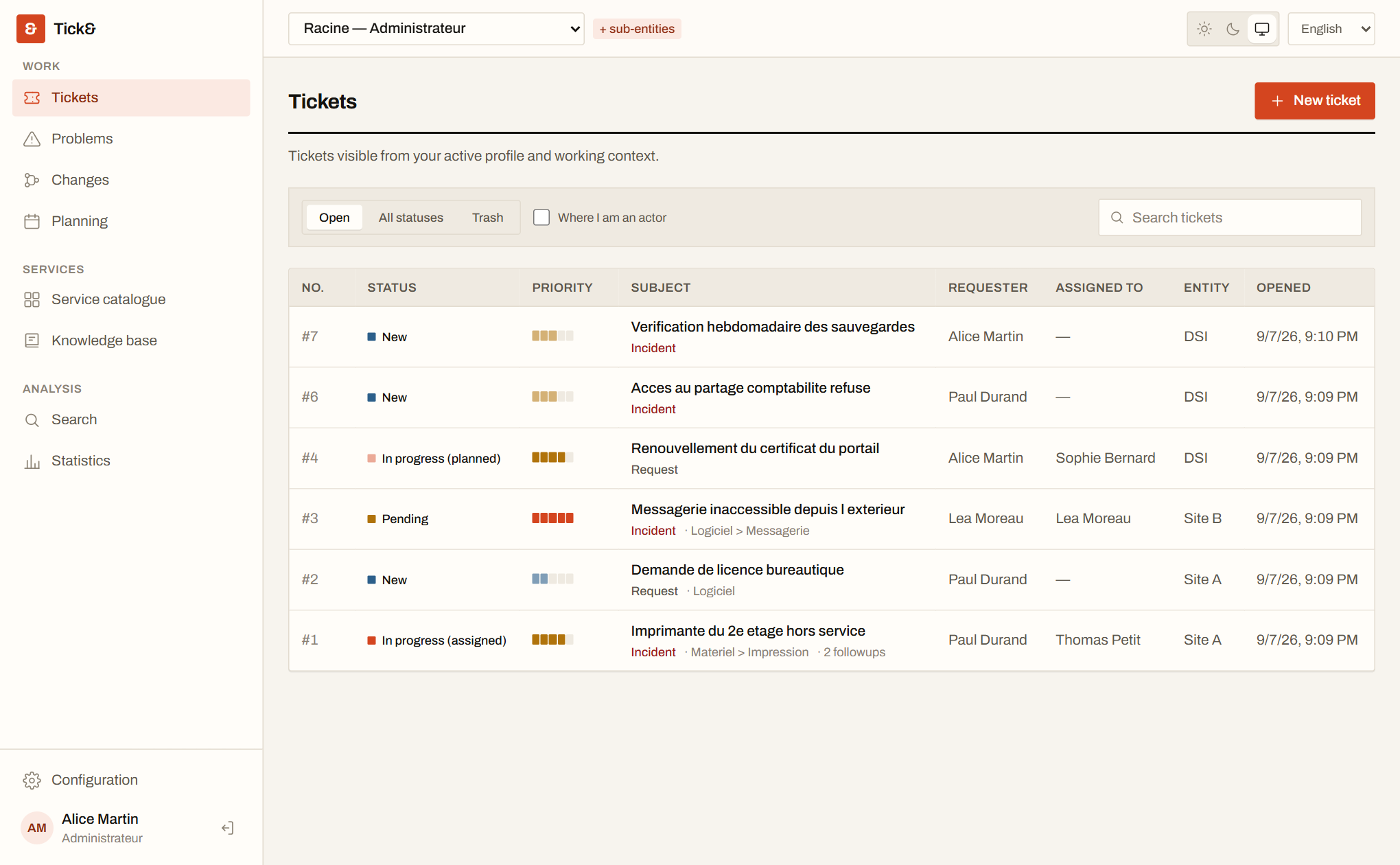
What Tick& covers
Seventeen functional modules, and an API of 183 operations documented in OpenAPI.
Multi-organisation, enforced by the database
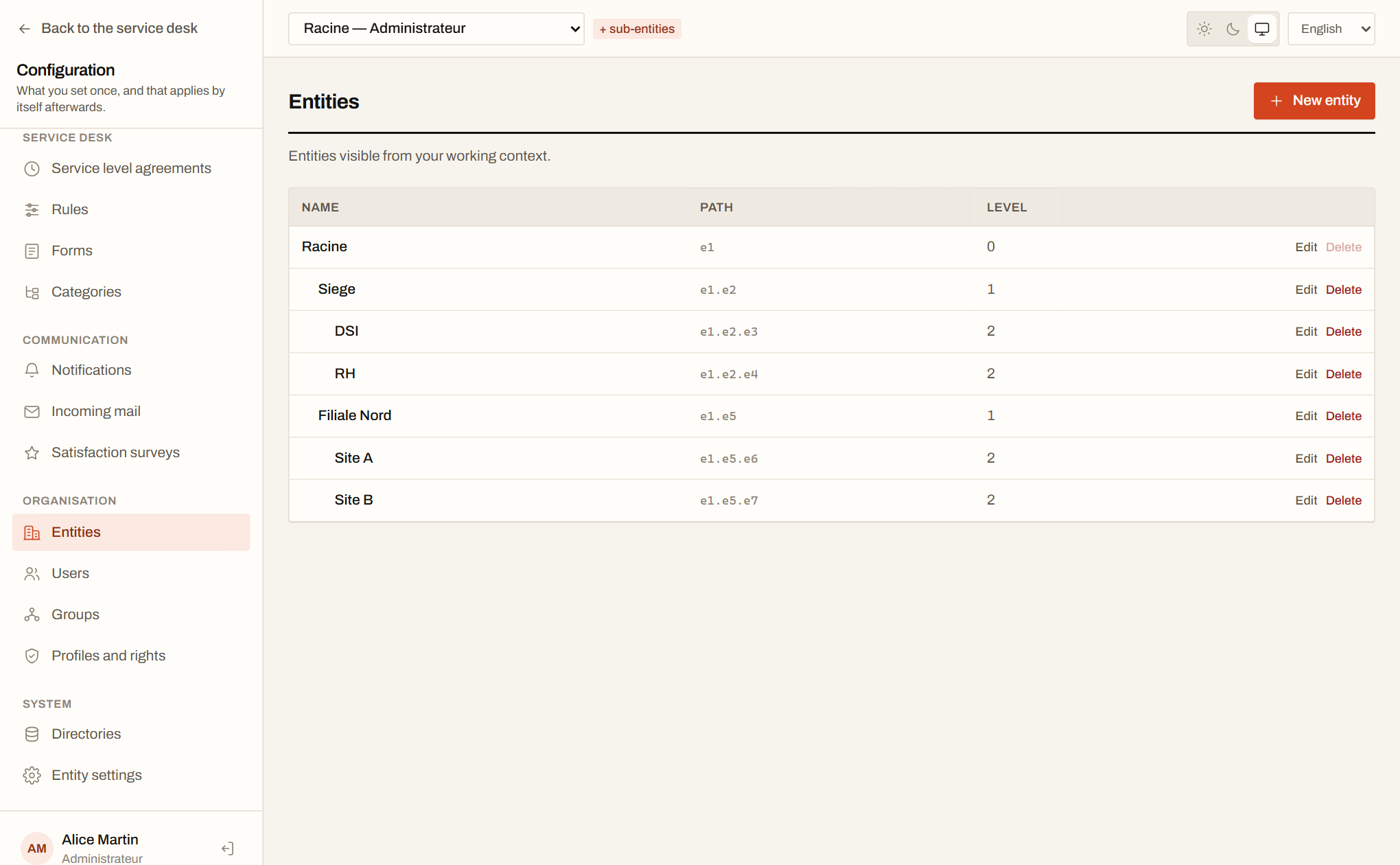
Entities form a tree, and isolation rests on PostgreSQL Row-Level Security — not on conditions somebody can forget to write.
The full ITIL cycle
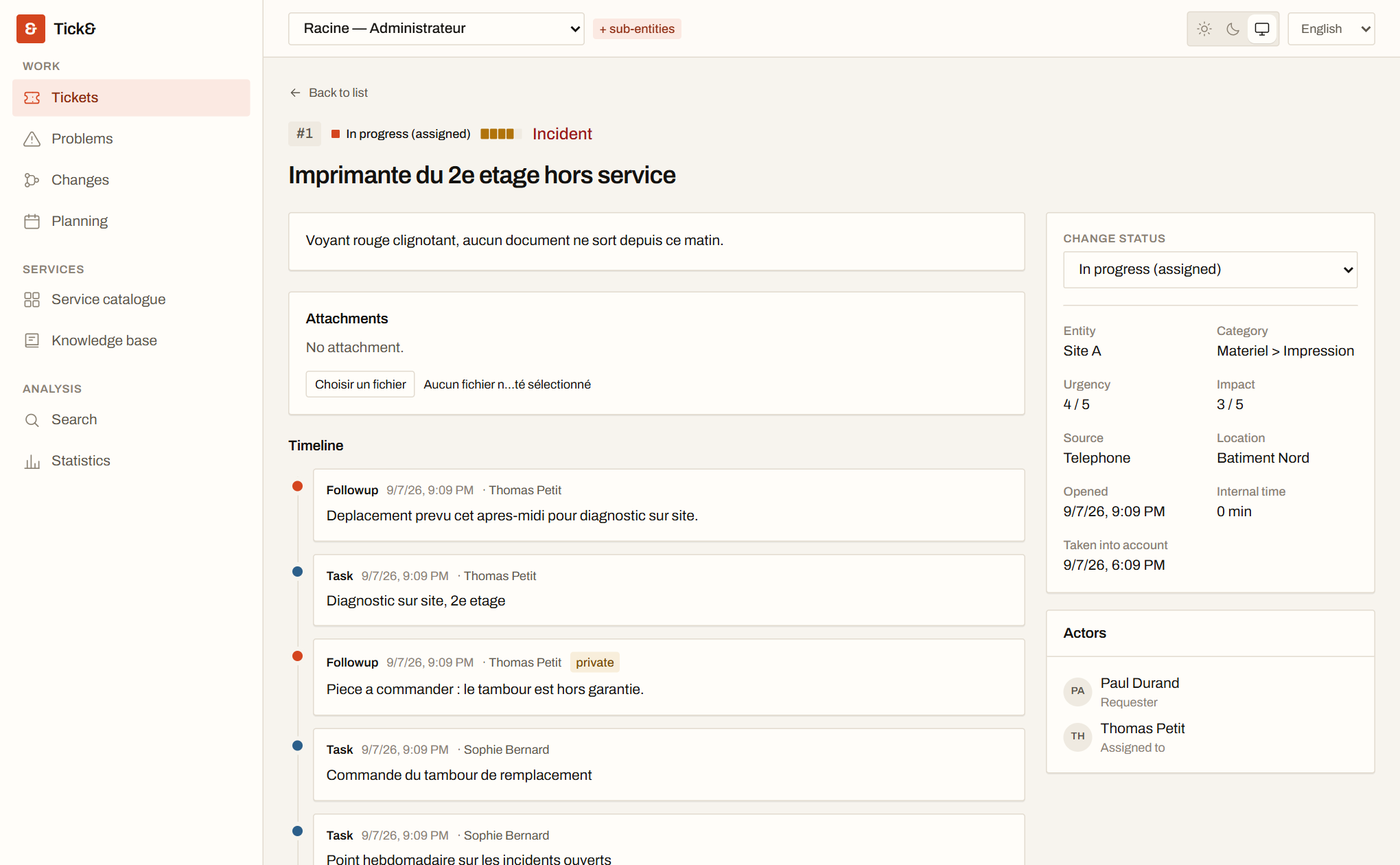
Tickets, problems and changes share one foundation: actors, a unified timeline, tasks, solutions, approvals, links between objects, and promotion of an incident into a problem.
Service levels and escalation
Working-hour calendars, SLAs and OLAs, reminders before the deadline, escalation to a supervisor. Deadlines are computed on working time, not on wall-clock time.
Rule engine
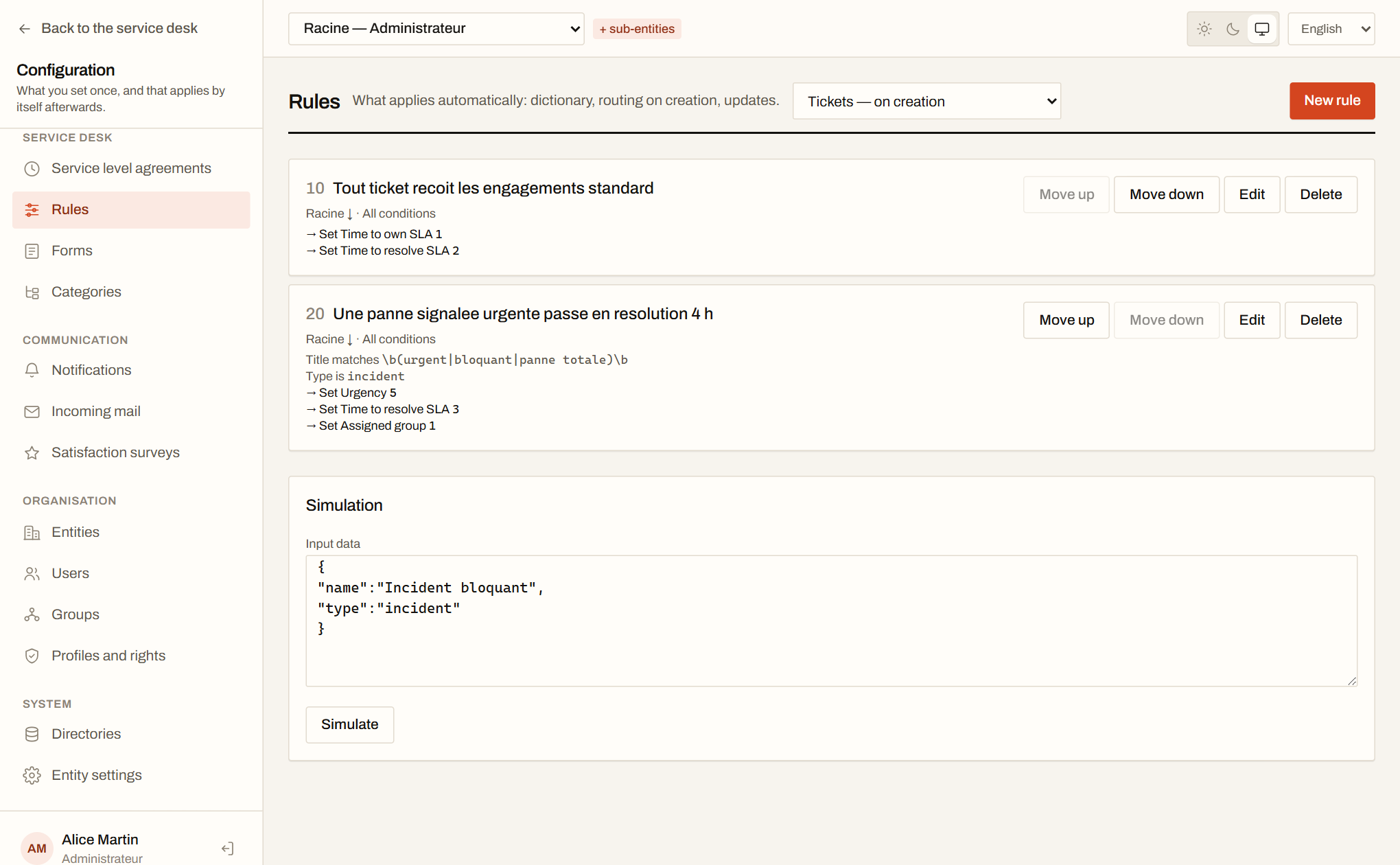
Categorisation, routing on creation, automatic updates. A simulator shows what a rule would do before it ever touches a real ticket.
Self-service and knowledge base
A service catalogue with conditional forms, a public FAQ, a simplified interface for requesters, and satisfaction surveys.
Inbound and outbound email
Template-driven notifications, and a mailbox collector that turns an email into a ticket and attaches a reply to the right thread.
Reporting
Planning, statistics, dashboards, CSV and PDF exports. Target attainment and average times read per entity and per period.
Extensible without forking
Plugins load in-process, declare their permissions and settings in a versioned manifest, get their own PostgreSQL schema, and uninstall without leaving traces. A first plugin, attached to every release, announces tickets in Mattermost, Slack or Teams. A plugin that only uses the published interface ships under a licence of its author's choosing: the core is AGPL, plugins are excepted.
French and English
Interface and emails in both languages from day one, following the browser's language or the user's explicit choice.
On your own servers
Tick& is self-hosted. Your tickets stay on your infrastructure, and nothing leaves for a third party.
Docker and Podman
Images published with every release. One compose file, five services, migrations run once by a dedicated service rather than at every container start.
Linux, without containers
System packages, a systemd unit and nginx, from a self-contained release archive. The procedure was carried out end to end on a clean Debian machine.
Windows Server
A Windows service and IIS, from a platform-specific archive. For organisations that do not run Linux servers.
PostgreSQL and Redis
Two dependencies, both open source. Tick& can also point at a managed cluster you already run instead of shipping its own.
Authentication
Local accounts, or LDAP and Active Directory, with group import and automatic profile assignment.
Documented REST API
The OpenAPI description is derived from the controllers: it can neither omit an existing route nor describe one that is gone.
Five accounts, five scopes
The demo is seeded with five accounts, shared password tick. Each
illustrates a case the entity model has to handle — switching accounts is how you see
the isolation at work.
-
sophie— Supervisor on Filiale Nord, recursive. Sees a whole branch and its descendants, without a glimpse of headquarters. The one to try first: it sees the most without being an administrator. -
admin— Administrator on Racine, recursive. Full access to the tree, and the configuration screens: rules, service levels, entities, profiles and rights. -
thomas— Technician on Site A, non-recursive. A single entity, without its descendants. The contrast withsophieshows what recursion actually changes. -
lea— Technician on Site B and Self-service on Siege. Stacked authorizations: rights follow the active profile, never the union of all of them. Switching context at the top of the screen changes what is visible. -
demandeur— Self-service on DSI. The simplified interface: submit, follow, reply, without seeing any of the technician tooling.
No sign-up, no data collected. Everything resets on the hour — write, break, delete.
Tick& is not alone
Two tools, one family: same stack, same conventions, same visual writing. A single colour tells them apart.
Flow& — browser automation
Bots written in TypeScript, run on behalf of a whole organisation, with the log, the progress and the live view of what they are doing. When something breaks, the screenshot of that moment and the Playwright trace are right there on the page.
Where the project stands, said plainly
Software you are asked to install on your own servers should state its limits before you spend an evening on it.
- Never used by a real service desk. The public demo runs the released images on a server behind a TLS proxy, so the deployment path is exercised every day. But nobody has yet handled real tickets with Tick&.
-
Version
0.1.12is an early tagged release, not a proven one. Expect breaking changes between minor versions until the interfaces have been exercised by someone other than their author. -
The plugin SDK is still
0.xand may break between minor versions. It will only freeze once every extension point has been exercised by real use. - What is solid: seventeen modules covered, 2,616 tests including integration tests against a real PostgreSQL database that check isolation between entities, and 69 end-to-end journeys run in a real browser against the real API. Upgrading from the previous release and restoring a backup are replayed on every change. Continuous integration builds the images and refuses to publish a release whose number does not match its manifest.
Feedback, bug reports and trial plugins are useful now.